What Was One Reason That Southern States Passed Laws After 1800 to Discourage Manumission?
The laws of early on South Carolina viewed enslaved people equally individual property that individual owners could trade, sell, and fifty-fifty emancipate equally they saw fit. That liberty allowed numerous slave owners to set complimentary an unknown number of men, women, and children with little or no interference from the regime. Today we'll explore this miracle of private manumission—the most common legal pathway from slavery to freedom—from the colonial era to the government interventions of the early nineteenth century that restricted and finally prohibited this traditional practice.
From the earliest stages in the gestation of the Carolina colony in the 1660s, the Lords Proprietors planning this endeavor intended the English language and other white settlers to make use of unfree labor. Virginia, Barbados, and the other English colonies in the Caribbean began exploiting the labor of African captives in the decades before the cosmos of Carolina, and the commencement settlers who arrived at Charles Town in the 1670s apace followed their instance. The population of Due south Carolina—including enslaved people of African descent—grew slowly at get-go, and the early white inhabitants did not prefer whatever special laws to articulate the legal abilities and disabilities of slaves until the spring of 1690/1 (chosen Human activity No. 57 by the editor of the nineteenth-century The Statutes at Large of South Carolina). From that point forwards, the South Carolina General Assembly revised and expanded the colony's legal lawmaking "for the improve ordering of slaves" in a succession of statutes adopted in 1695/half-dozen (Act No. 141), 1698 (Act No. 168), 1701 (Human activity No. 191a), and 1712 (Act No. 314).
In the shadow of the expanding legal framework of slavery in S Carolina during the belatedly-seventeenth and early on-eighteenth centuries, contemporary records such every bit wills and land conveyances provide clues to the presence of a handful of people of African descent living in liberty in the Charleston area. We accept very little information nigh their identities or their corresponding paths to freedom, unfortunately, and the laws of Due south Carolina took no find of "free persons of colour" during the first half-century of this settlement.
As I mentioned in last calendar week's program, the provincial regime first articulated a legal machinery for the public manumission of enslaved people in 1703, but that public machinery always represented an extremely narrow and rarely-tread path to freedom. The vast bulk of the small population of costless persons of color in early South Carolina did not gain emancipation from slavery past performing extraordinary acts of bravery or fidelity, but rather through a relatively unproblematic process we might phone call "private manumission."
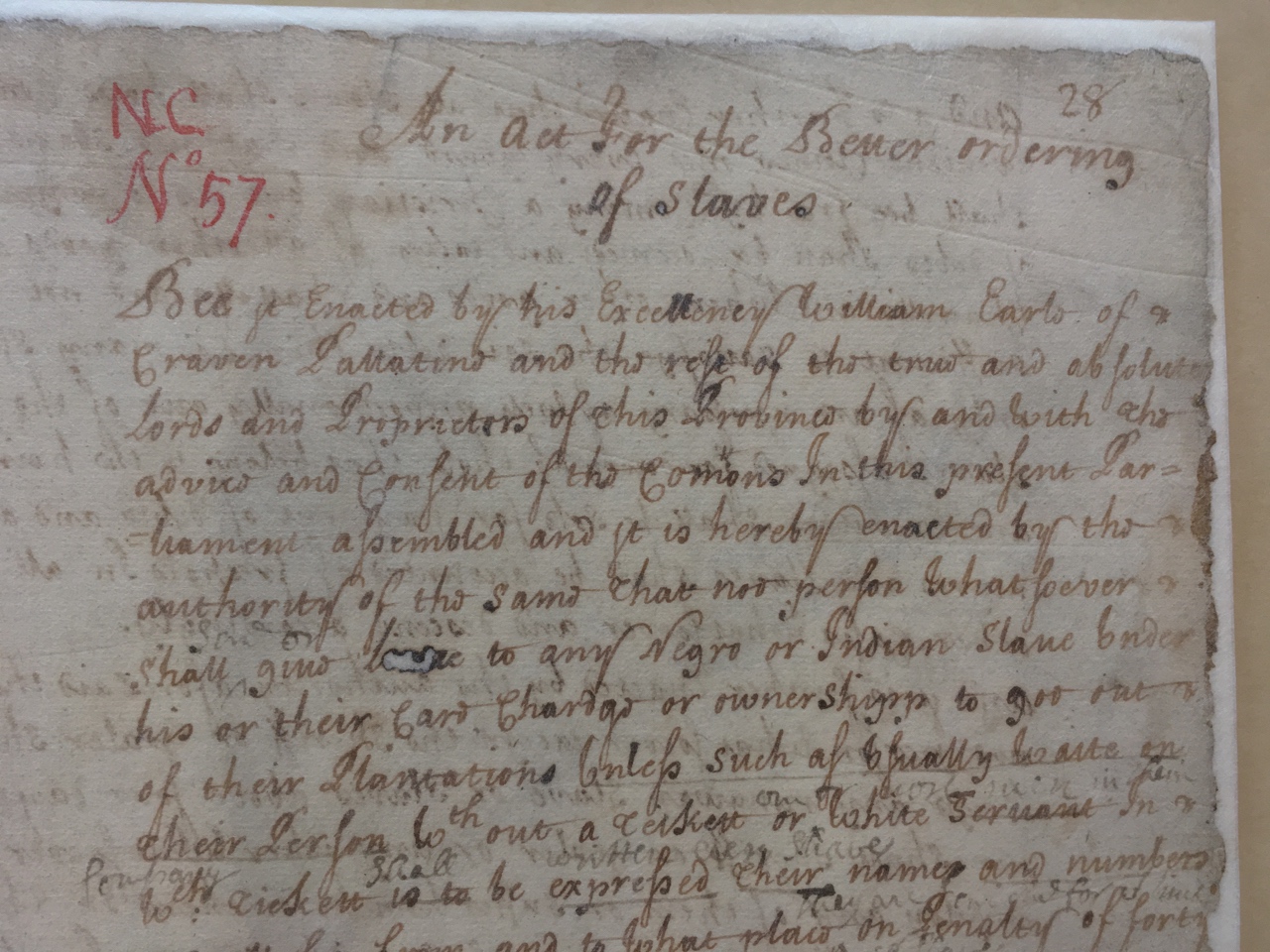 While the laws of early on South Carolina deemed slavery to be the normal and "proper" institution for decision-making people of African descent, our government simultaneously respected the right of individual citizens to dispose of their private holding in whatsoever manner non specifically prohibited by law. That right extended to the do of owning human being beings for virtually, but not all, of the 195 years in which the laws of S Carolina protected that beastly do. The law viewed enslaved people as chattel or moveable property who could be legally traded, sold, or otherwise transferred from one party to some other like inanimate objects or heads of livestock. If the owner of an enslaved human beingness desired to manumit or free him or her, for whatever reason, the owner could simply and unilaterally declare that person henceforth to be free.[one]
The early laws of Southward Carolina proscribed no formula for such acts of individual emancipation nor mandated any specific documentation to record them. Nevertheless, experience taught virtually parties that the creation of a simple written declaration of the fact was helpful to all concerned. Free people of color were an anomaly in the slave-holding landscape of early S Carolina, and their precarious liberty was bolstered by the possession of a document memorializing their path to freedom. The legal requirement for such documentation became more stringent in after generations, merely let's stick to the early on days for the moment.
Every bit I mentioned earlier, there is very little surviving evidence of the earliest gratis people of colour in the Lowcountry of South Carolina. We know next to nothing most their identities and numbers, merely we know that the practice of private manumission was going on. We also know that some members of the white community were troubled by the growing number of formerly-enslaved people. The appearance of an enslaved black majority in the early years of the eighteenth century fueled the rise of general concerns about the safety of the white minority. Complimentary people of colour, existing between the dominant poles of society, represented to some white citizens a sort of suspicious liability. Denied the privileges of total citizenship, they could potentially become burdens to the prejudiced white community when injured or elderly. Free of the concrete controls that subjugated the enslaved population, complimentary people of color might also initiate racial violence on behalf of their convict brothers and sisters.
To accost these and other safety concerns, the Southward Carolina Full general Assembly ratified another major revision of the constabulary "for the improve Ordering and Governing of Negroes and other Slaves" in February of 1722. The amended statute did not prohibit or even curtail the do of private manumission; rather, information technology sought to check the farther growth of the colony'southward population of formerly-enslaved people by effectively banishing newly-emancipated people from South Carolina. The thirty-ninth paragraph held slave owners responsible for the timely removal of whatever person they might privately liberate from the bonds of slavery, in the post-obit words:
"And be it further enacted . . . That all owners of slaves, who, at any time hereafter, shall manumit or set gratis any slave, for whatsoever particular service, shall brand provision for his departure out of this province; and such slave who shall non depart this province, past the space of twelve months side by side after such manumission, (beingness at freedom so to do,) shall lose the benefit of such manumission, and proceed to exist a slave, to all intents and purposes whatsoever, unless such manumission shall exist approved of and confirmed by an order of both Houses of Assembly."[2]
The next major revision of Southward Carolina'south "slave code," ratified in the leap of 1735, repeated the 1722 clause requiring newly-freed slaves to leave the province, merely shortened the legal timeframe of their departure from twelve months afterwards manumission to just six months. Furthermore, the revised law added a clause intended to discourage such emancipated people ever from returning to Due south Carolina. If, later on having been privately manumitted and having departed from the province, such complimentary persons of color returned here, the 1735 act stated that they "shall lose the benefit of such manumission and freedom, and go on to be a slave to all intents and purposes whatsoever, to be sold past the public treasurer for the use of the public, unless such manumission exist approved of and confirmed by an order of both Houses of Associates."[3]
The legal framework of slavery in South Carolina's history is such a thorny and confusing morass of evolving regulations, requirements, and revisions that information technology's easy to become confused by the details. In that location are a number of very reputable scholars, for example, who indicate to the colony's side by side major revision of the slave code, adopted in the leap of 1740, and declare that it mandated the practice of banishing newly-manumitted persons from Due south Carolina. That sweeping, draconian slave constabulary, enacted in the wake of the bloody Stono Rebellion of September 1739, certainly exhibits a potent caste of white paranoia, simply information technology is, in fact, quite silent on the field of study of manumission. The "Negro Act" of 1740, as it was once ordinarily chosen, consists of a preamble and l-eight paragraphs, only my tired eyes detect within that lengthy text no restrictions on individual manumission, and no requirement obliging newly-emancipated people to depart from the province.[4]
In other words, S Carolina's famously awful "Negro Human activity" of 1740 marks a sort of tipping point in the state's African-American history because of its tacit acceptance of the practise of individual manumissions. By omitting a very specific and ostensibly important provision contained in the two previous versions of the colony'southward slave lawmaking, designed to suppress the numbers of free persons of color, provincial lawmakers had decided either that the banishment clause was ineffective, or that the presence of formerly-enslaved people in S Carolina was non a serious business concern. In either case, the silence of the 1740 act regarding private manumissions coincides with the advent of a more robust collection of records documenting the practice.[5]
 For example, in the spring of 1740, the executors of the estate of the late John Breton, formerly a merchant of Charleston, sought permission from the South Carolina Full general Associates to manumit an enslaved man named Sambo, in accordance with Breton's concluding volition and testament. Sambo apparently planned to remain in South Carolina, so Breton's executors followed the prescriptions of the Negro Act of 1735 and petitioned the provincial legislature to legitimize his residence. Both houses of the Assembly and the governor approved the request, and Sambo, for all we know, never left South Carolina. One week after confirming Breton'south concluding asking, the legislature ratified the "Negro Deed" of 1740 that omitted the very requirement that had driven his executors to petition the authorities in the first place.[half-dozen]
One yr later, in the summer of 1741, the widow Mary Basden of Charleston expressed a like want in her final will and testament. She wished to manumit an enslaved woman named Flora after her decease, and hoped that "the Full general Assembly or whom else it may business concern may consent to the said manumission of my said slave without obliging her to leave this province." Mary might non have been familiar with the revised slave law of 1740, only her executors were more up-to-engagement. Mrs. Basden died a few weeks subsequently making will, and Flora was freed without interference from the government. The executors of Mary Basden were not obliged to seek public (legislative) blessing of this private manumission, and they did not petition the General Associates on Flora'due south behalf.[7]
The aforementioned examples of Sambo and Flora illustrate the most common legal pathway out of slavery in early Southward Carolina—that is, by means of the slave owners' terminal will and testament. Many slave owners—especially those in the second half of the eighteenth century—included a clause in their respective wills directing their executors to manumit a specific, named enslaved person or persons, after the death of the said testators. Virtually just directed their executors to free a person without providing any clues to their motivation. In his 1772 will, for example, Charleston merchant Othniel Beale instructed his executors to distribute his numerous slaves amongst his heirs, "except Robin the Bricklayer to whom I practice hereby requite his freedom at the time of my death." Based on Robin'southward stated trade as a brick mason, nosotros tin can plausibly imagine that Othniel Beale profited from Robin's manufacture during his lifetime and perhaps sought to reward the enslaved man as a final gesture of cheers. Such conclusions are based on the estimation of sparse text, however, and the real story might be far more complex.[8]
In contrast to that taciturn, passive expression of appreciation, other testators used more articulate linguistic communication in their wills to explain their proposed acts of manumission to subsequently readers. In such relatively rare cases, we detect the kernels of intriguing human stories that provide a modicum of insight into those now-distant lives. Mary Basden, for example, articulated a clear reason for wanting to manumit Flora in 1741: "In consideration of the faithful services of my Negro adult female Flora I do hereby requite her her freedom and do manumitt [sic] and belch her from all Slavery whatsoever . . . as I take long experienced her to be a faithful simply honest and laborious woman." Every bit a further reward to her enslaved companion, Mary Basden also directed her executors, following her death, "to pay to the said Flora the sum of xxx pounds currant [sic] coin [of South Carolina] as a further token of my value for her."
In an fifty-fifty smaller number of extant wills, some testators deployed oblique language and sentiments that we might be inclined to interpret as expressions of filial affection. One or 2 of these very rare documents might address the thing directly, simply well-nigh simply brim effectually the topic of miscegenation, or the reproductive mixing of dissimilar "races." I'll cite merely one example to give you a flavor of this interpretive quagmire. Hugh Cartwright of Charleston was a master bricklayer who owned dozens of enslaved laborers who generated significant income that he invested in real estate speculation. In the spring of 1752, 30-something-yr-old bachelor Cartwright penned a cursory annotation directing the executors of his time to come estate to manumit two young children after his decease. Hugh's curious document, which is like a volition but is non actually a will, does not explicitly merits paternity of the said children, merely the emphatic nature of his instructions suggests—at least to me—that Cartwright was their begetter. Since it's a rather unusual document, I'll give you the entire text:
"Know all men past these presents that I Hugh Cartwright of Charles Town in the province of South Carolina bricklayer as well for the good will I accept for my mullatto [sic] boy named Dick & for my mullatto [sic] girl named Sally as for divers other expert causes & considerations me hereunto moving have given and granted and by these presents do give and grant unto the said Dick and Salley and to each of them their freedom from and immediately after my expiry hereby manumising [sic] enfranchising & discharging from the bail of slavery fully freely clearly and admittedly them the said Dick & Sally and each of them and then that my heirs ex[ecut]ors or adm[inistrat]ors nor whatsoever other person or persons whatsoever for them or either of them or in their or either of their names shall or may hereafter claim claiming or demand any mode of dues duty or service from them the said Dick and Salley or from either of them to have concur and injoy [sic] the freedom & enfranchisment [sic] aforesaid with all privileges appertaining thereunto unto the said Dick and Salley and each of them from and immediately later the decease of me the s[ai]d Hugh Cartwright as fully and amply to all intents and purposes as if they the s[ai]d Dick and Salley had been actually built-in free."[9]
 Scarce footling information survives about the human Hugh Cartwright, simply at least we know that he really, really wanted Dick and Sally to be free. I've been excavation into this example for a while, and I oasis't the slightest inkling to the identity of their enslaved female parent. Simply over a yr after creating the aforementioned document, which might have followed the nascency of aforementioned mulatto children, Cartwright fabricated his formal will in the autumn of 1753. In it, he repeated the instructions for manumitting the children he called "my mulatto boy named Dick and my mulatto daughter slave named Sally." In addition, he directed his executors to invest £1,000 current money of South Carolina (approximately £143 sterling) in some interest-begetting account and to hold such funds in trust for the aforenamed children. It was his desire, said Mr. Cartwright, "that the involvement coin arising from the loan thereof shall be practical towards the support and maintainance [sic] of the said male child and girl during their minority and when they attain their respective ages of twenty 1 years then the said sum of thou pounds [is] to be equally divided between the said mulatto male child and girl."[10] Hugh Cartwright and the several executors of his estate were dead long before Dick and Sally reached adulthood, unfortunately, and I oasis't yet establish whatsoever trace of their fates.
We could keep to sample the texts of various manumissions for hours, but time compels me to push forward with the chronology of this topic. The manumission of enslaved people past individual parties was the most common legal path to freedom in eighteenth-century South Carolina, and the slave owner'due south last will and testament was the most common instrument for effecting that freedom. This private practice grew from a tentative start in the early on years of the century and swelled during the 2d half of the 1700s. At the plough of the nineteenth century, all the same, the S Carolina Full general Associates voted again to curtail the practice. Their complaint was not necessarily the general growth of the population of costless persons of color, merely the manumission of persons who were, for 1 reason or another, unable to support themselves independently. In the minds of the legislature, therefore, the relative simplicity of the emancipation process had created a social welfare trouble that the state was unwilling to address.
The seventh paragraph of "An Human action respecting Slaves, Free Negroes, Mulattoes and Mestizoes; for enforcing the more than punctual performance of patroll [sic] duty; and to impose certain restrictions on the emancipation of slaves," ratified in December 1800, complained that "information technology hath been a practice for many years by in this country, for persons to emancipate or set gratuitous their slaves, in cases where such slaves have been of bad or depraved character, or, from age or infirmity, incapable of gaining their livelihood by honest means." In order to discourage the hereafter emancipation of such people, the state legislature established a new, more rigorous protocol for private manumission. From now on, slave owners desiring to complimentary a slave must notify a local magistrate, who would then summon v local freeholders to inspect and interview the said enslaved person in order to make up one's mind whether or not he or she was capable of "gaining a livelihood in an honest way." If they approved of his or her graphic symbol and abilities, the magistrate and freeholders were required to draft a certificate testifying to the same. Copies of this certificate, along with a formal deed of manumission created past the slave owner, must be delivered to the formerly enslaved person and recorded by the clerk of the local district court inside 6 months from the engagement of the transaction. Private manumissions performed henceforth in whatsoever other, less-rigorous style would be void and of no issue.[11]
As white South Carolinians in general, and Charlestonians in particular, grew more paranoid about the growth and influence of the state'due south population of costless persons of color, a number of citizens lobbied for the closure of all legal pathways by which enslaved people might gain their liberty. Nearly two years before the Denmark Vesey matter ignited a burn storm of white distrust of the gratuitous colored population, the South Carolina Assembly responded to popular sentiment past ratifying a constabulary that effectively prohibited future emancipations. "An Act to Restrain the Emancipation of Slaves, and to Forbid Free Persons of Color from Entering into this State," ratified on December 20th, 1820, ended the traditional practice of private manumissions that had flourished for more than a century with one, unambiguous sentence: "Be information technology therefore enacted, by the honorable the Senate and House of Representatives, now met and sitting in General Assembly, that no slave shall hereafter be emancipated but past act of the Legislature."[12]
From that moment in late 1820 to the spring of 1865, the only legal pathway from slavery to freedom in South Carolina was to gain the sympathy of the majority of the bourgeois white men who formed the state's General Associates. That job was, of class, rendered nearly incommunicable by the deeply prejudiced attitudes that dominated local politics at that time. Nevertheless, some people did try to access that narrow window of opportunity. I'll give y'all just one example to illustrate the sort of private conundrums created by the government's decision to cancel the customary exercise of private manumission.
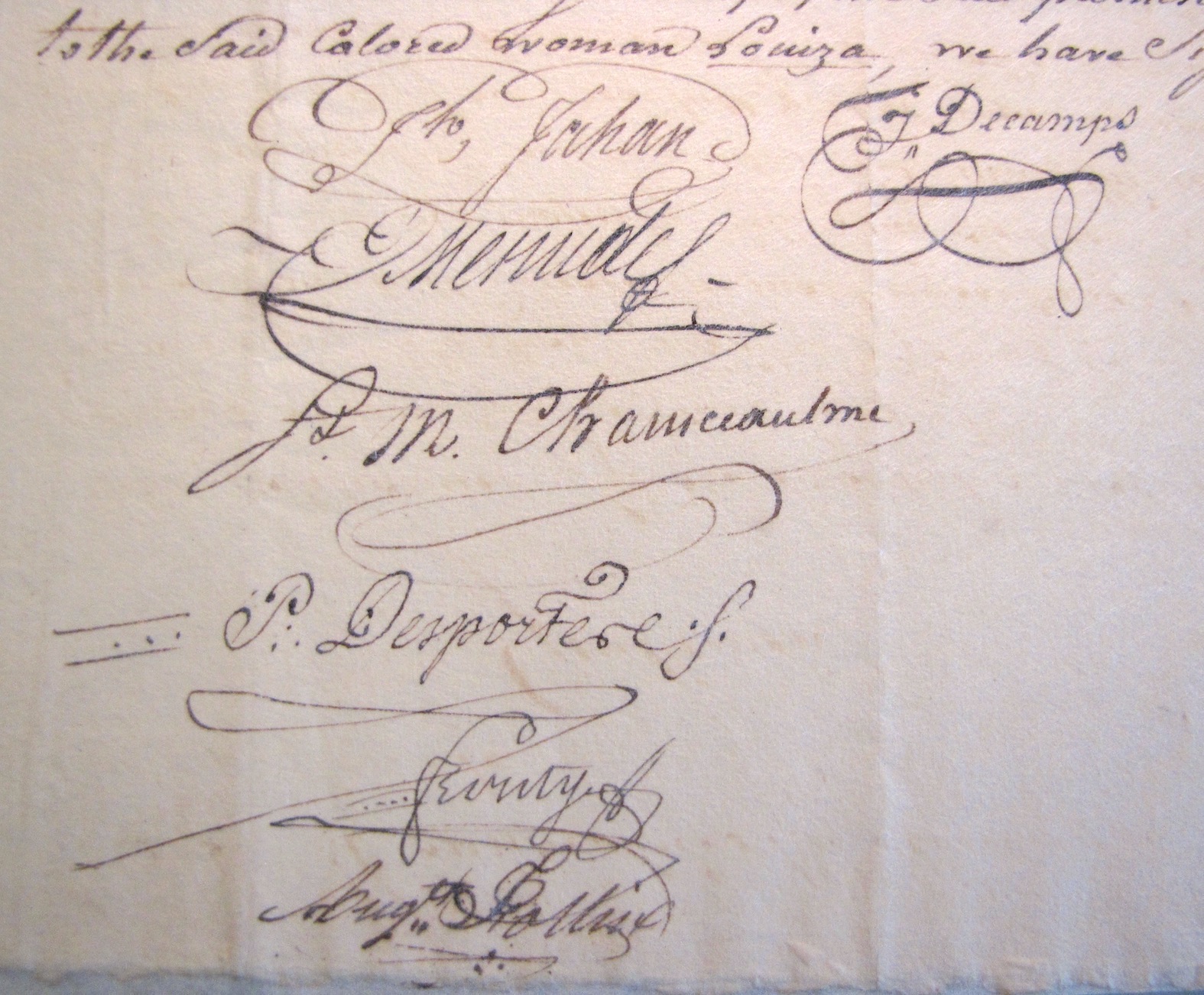 Isadore Labatut, a French refugee who came to Charleston in the late 1790s, petitioned the Due south Carolina General Associates in 1823 seeking permission to manumit an enslaved woman and her children. "During twelve years of a painful affliction," said Monsieur Labatut, he had received "the about important services from a colored adult female named Louiza, my property, with 4 children aged now, 8 years, 6 years, 3 years and the youngest fifteen months." On three occasions Louiza had also saved her master, who was now profoundly deaf, "from dreadful fire at dark by her vigilance." In consequence of her constant care and valuable services, Labatut informed the legislature that he had "promised her six years agone (that is, around 1817), in social club to remunerate her good comport and good morals, to emancipate her, together with her children." This hope of freedom had been fabricated in the presence of many witnesses who also signed Labatut'southward petition, merely the state'due south 1820 law now prevented him from privately manumitting his chattel property. The Frenchman at present asked South Carolina'due south lawmakers, "in the name of humanity . . . to take his petition into consideration, and to grant the permission to proceed [my] hope, every bit a man of honor, in emancipating the said colored adult female Louiza with her four children as she is very worthy of such a advantage for her good qualities and behaviour." In response to Isadore Labatut's impassioned plea, the S Carolina Senate and House of Representatives did zippo. Louiza and her children would accept to expect until 1865 to enjoy their freedom.[xiii]
As we head towards a conclusion to today'southward topic, I'd similar to make a few observations nigh the documentary records that allow u.s.a. to delve into the history of private manumissions in early South Carolina. Commencement, it's important to remember that the people who transitioned from slavery to freedom past way of such individual manumissions represent simply a tiny fraction of the much larger population of enslaved people who one time lived and worked here. For the vast majority of those many tens of thousands of people, nosotros accept no surviving records of their lives. Their labors, their struggles, their stories, take all passed silently into the shadows of the by, but we must non forget them.
2d, the surviving records of individual manumissions demonstrate that this legal path to freedom was, in a manner of speaking, a privileged miracle, unavailable to most enslaved people. Think almost the examples I've cited today, of Sambo, Flora, Robin, Dick, Sally, and Louiza. These enslaved people all lived, worked, and existed in some close proximity to their owners. That proximity nurtured the germination of some sort of human relationship, and that personal connection provided the slave possessor with an opportunity to acknowledge the humanity and value of his or her chattel property. That acknowledgement occasionally inspired slave owners to unlock the legal bonds of slavery and emancipate their metaphorical brothers and sisters, or their literal sons and daughters. As the fruit of prolonged physical proximity, private manumission was across the accomplish of those enslaved people who enjoyed few opportunities for personal interaction with their respective owners. Private manumission in early South Carolina was, therefore, largely an urban phenomenon located primarily in Charleston. In rural contexts, it was largely confined to domestic situations and thus unavailable to the people who labored more anonymously in the field.
Finally, I'll shut with a call for action. Today I've cited a handful of examples of private manumission drawn from extant probate records and from the Miscellaneous Records of the Secretary of Land, a large collection of documents housed at the South Carolina Section of Archives and History in Columbia. These two record groups form the principal sources of the surviving evidence of manumissions in early on South Carolina, and bear witness of free persons of color in general. Anyone who has spent whatsoever time turning the pages of these valuable records knows this to be true. Prove of individual manumissions can be found elsewhere, such as in legislative journals, but in much smaller proportion. Despite the relative ease of access to these celebrated materials, I am not aware of any systematic effort to inventory the surviving records of private manumissions in early South Carolina. The chore of combing through the extant probate and Miscellaneous Records would not be terribly difficult, but information technology will occupy a swell number of hours and perhaps crave the efforts of a series of individuals. How many examples of private manumissions exist in the early on public records of South Carolina? Dozens? Hundreds? More than a chiliad?
I've currently got a lot on my plate with the Charleston Time Auto and dozens of unfinished book projects, then I'm going to defer this challenge to another ambitious historian or group of historians. The legacy of individual manumissions forms an important and underutilized role of South Carolina's history, and that legacy needs a champion.
[1] Eugene Sirmans, "The Legal Status of the Slave in South Carolina, 1670–1740," Journal of Southern History 28 (Nov 1962): 462–73, argues that the primeval enslaved people in Due south Carolina, as in early on Virginia, were not considered chattel property. Their status as chattel was beginning implied by the slave act of 1696, but non confirmed until the major revision of 1740.
[ii] Come across section 39 of Act No. 476, "An Act for the better Ordering and Governing of Negroes and other Slaves," ratified on 23 February 1721/2, in David J. McCord, ed., The Statutes at Large of South Carolina, volume 7 (Columbia, S.C.: A. S. Johnston, 1840), 371–84.
[3] See section 35 of Human action No. 586, "An Act for the better ordering and governing Negroes and other Slaves," ratified on 29 March 1735, in McCord, Statutes at Large, 7: 385–97.
[iv] A survey of the legal repercussions of the Stono Rebellion tin can be establish in Robert Olwell, Masters, Slaves, and Subjects: The Culture of Ability in the South Carolina Depression State, 1740–1790 (Ithaca: Cornell University Press, 1998). See also Mark Smith, ed., Stono: Documenting and Interpreting a Southern Slave Revolt (Columbia: Academy of Due south Carolina Press, 2005).
[v] See Human activity No. 670, "An Act for the better Ordering and Governing Negroes and other Slaves in this Province, ratified on 10 May 1740, in McCord, Statutes at Large, vii: 397–417.
[6] Come across J. H. Easterby, ed., The Journal of the Eatables House of Assembly, September 12, 1739–March 26, 1741 (Columbia: Land Commercial Printing Visitor for the Historical Committee of South Carolina, 1952), 324–27, 330 (ane and three May 1740). The will of John Breton, merchant, dated 3 October 1738, recorded on 12 November 1739, specified that Sambo "shall serve only ane year later my death and immediately thereafter shall be fix at liberty." See W.P.A. transcript volume 4 (1738–xl), 215–sixteen.
[7] The volition of Will of Mary Basden of Charleston is dated 12 June 1741 and was recorded on vii July 1741; meet Westward.P.A. transcription volume five (1740–47), xx–22.
[eight] The will of Othniel Beale, dated __ September 1772, and proved xxx July 1773, is institute in W.P.A. transcription volume 15B (1771–74), 573.
[9] South Carolina Section of Athenaeum and History (future SCDAH), Miscellaneous Records of the Secretary of State, 2I: 205; also found in WPA transcription vol. 80A: 303. The term "enfranchisement" appears in the wording of some manumission documents, but such apply is misleading. During the long era of slavery in South Carolina, emancipated people were never completely "enfranchised"; that is to say, they never enjoyed to total rights of citizenship until later the ratification of the Thirteenth (1865), Fourteenth (1868), and Fifteenth Amendments (1870) to the United States Constitution.
[x] The volition of Hugh Cartwright, dated xiii Baronial 1753 and proved on xiv September 1753, is plant in West.P.A. transcription volume 81: 115–18.
[11] See sections 7–9 of Act No. 1745, "An Deed respecting Slaves, Free Negroes, Mulattoes and Mestizoes; for enforcing the more than punctual performance of patroll [sic] duty; and to impose sure restrictions on the emancipation of slaves," ratified on 20 December 1800, in McCord, Statutes at Big, 7: 440–43.
[12] Meet Act No. 2236, "An Act to restrain the emancipation of slaves, and to prevent gratuitous persons of color from inbound into this state, and for other purposes," ratified on xx December 1820, in McCord, Statutes at Large, vii: 459–60.
Source: https://www.ccpl.org/charleston-time-machine/private-manumission-intimate-path-freedom
0 Response to "What Was One Reason That Southern States Passed Laws After 1800 to Discourage Manumission?"
Post a Comment