In Art Can Be Defined as a Moving Dot
Line
A line is defined as a mark that connects the space between two points, taking any form along the way.
Learning Objectives
Compare and dissimilarity different uses of line in art
Cardinal Takeaways
Key Points
- Actual lines are lines that are physically present, existing every bit solid connections between one or more points.
- Implied line refers to the path that the viewer 'southward eye takes as information technology follows shapes, colors, and forms along whatsoever given path.
- Straight or classic lines provide stability and structure to a composition and tin can be vertical, horizontal, or diagonal on a work's surface.
- Expressive lines refer to curved marks that increase the sense of dynamism of a work of fine art.
- The outline or contour lines create a edge or path around the edge of a shape, thereby outlining and defining information technology. "Cross contour lines" delineate differences in the features of a surface.
- Hatch lines are a series of short lines repeated in intervals, typically in a unmarried direction, and are used to add shading and texture to surfaces, while cantankerous-hatch lines provide additional texture and tone to the image surface and tin can be oriented in any management.
Cardinal Terms
- texture:The experience or shape of a surface or substance; the smoothness, roughness, softness, etc. of something.
- cantankerous-hatching:A method of showing shading by means of multiple small lines that intersect.
- line:A path through 2 or more points.
The line is an essential chemical element of art, defined equally a marking that connects the space between two points, taking any course along the way. Lines are used most often to define shape in two-dimensional works and could be chosen the most ancient, as well every bit the near universal, forms of marker making.
There are many different types of lines, all characterized by their lengths being greater than their width, equally well as by the paths that they take. Depending on how they are used, lines assist to determine the motion, direction, and energy of a work of art. The quality of a line refers to the character that is presented by a line in gild to animate a surface to varying degrees.
Actual lines are lines that are physically nowadays, existing as solid connections betwixt i or more points, while implied lines refer to the path that the viewer's eye takes as it follows shape, colour, and form within an art work. Implied lines give works of art a sense of motion and keep the viewer engaged in a composition. We tin can encounter numerous implied lines in Jacques-Louis David's Oath of the Horatii, connecting the figures and deportment of the piece by leading the heart of the viewer through the unfolding drama.

Jacques-Louis David, Adjuration of the Horatii, 1784: Many unsaid lines connect the figures and activity of the piece past leading the center of the viewer through the unfolding drama.
Direct or classic lines add together stability and structure to a limerick and tin exist vertical, horizontal, or diagonal on the surface of the work. Expressive lines refer to curved marks that increase the sense of dynamism of a work of fine art. These types of lines frequently follow an undetermined path of sinuous curves. The outline or contour lines create a border or path around the edge of a shape, thereby outlining and defining it. Cross profile lines delineate differences in the features of a surface and can requite the illusion of three dimensions or a sense of grade or shading.
Hatch lines are a series of curt lines repeated in intervals, typically in a single direction, and are used to add shading and texture to surfaces. Cantankerous-hatch lines provide additional texture and tone to the image surface and can be oriented in any direction. Layers of cross-hatching tin can add rich texture and volume to epitome surfaces.
Lite and Value
Value refers to the utilise of light and nighttime in art.
Learning Objectives
Explicate the creative use of light and dark (also known as "value")
Key Takeaways
Key Points
- In painting, value changes are achieved past adding black or white to a color.
- Value in art is also sometimes referred to every bit " tint " for light hues and "shade" for dark hues.
- Values near the lighter cease of the spectrum are termed "high-keyed" while those on the darker end are called "low-keyed."
- In 2-dimensional art works, the employ of value can help to give a shape the illusion of mass or volume .
- Chiaroscuro was a common technique in Baroque painting and refers to clear tonal contrasts exemplified by very high-keyed whites, placed directly against very low-keyed darks.
Key Terms
- chiaroscuro:An artistic technique popularized during the Renaissance, referring to the use of exaggerated light contrasts in lodge to create the illusion of volume.
The apply of light and dark in fine art is chosen value. Value can be subdivided into tint (lite hues) and shade (dark hues). In painting, which uses subtractive color, value changes are achieved by adding black or white to a colour. Artists may also employ shading, which refers to a more subtle manipulation of value. The value calibration is used to show the standard variations in tones . Values about the lighter end of the spectrum are termed high-keyed, while those on the darker end are low-keyed.

Value scale: The value scale represents different degrees of low-cal used in artwork.
In two-dimensional artworks, the use of value can assist to give a shape the illusion of mass or book. It will also give the entire composition a sense of lighting. High contrast refers to the placing of lighter areas straight against much darker ones, then their difference is showcased, creating a dramatic effect. High contrast likewise refers to the presence of more than blacks than white or grey. Low-contrast images outcome from placing mid-range values together and then there is not much visible deviation betwixt them, creating a more than subtle mood.
In Baroque painting, the technique of chiaroscuro was used to produce highly dramatic effects in fine art. Chiaroscuro, which means literally "light-dark" in Italian, refers to clear tonal contrasts exemplified by very high-keyed whites, placed straight confronting very low-keyed darks. Candlelit scenes were common in Baroque painting as they finer produced this dramatic type of outcome. Caravaggio used a high dissimilarity palette in such works every bit The Denial of St. Peter to create his expressive chiaroscuro scene.

Caravaggio, The Deprival of St. Peter, 1610: Caravaggio's The Denial of St. Peter is an excellent example of how light can be manipulated in artwork.
Colour
In the visual arts, color theory is a torso of practical guidance to color mixing and the visual impacts of specific color combinations.
Learning Objectives
Express the virtually important elements of color theory and artists' use of color
Key Takeaways
Key Points
- Color theory beginning appeared in the 17th century, when Isaac Newton discovered that white light could be passed through a prism and divided into the total spectrum of colors.
- The spectrum of colors contained in white calorie-free are red, orange, yellow, green, blue, indigo , and violet.
- Color theory divides colour into the " primary colors " of cherry, yellow, and blue, which cannot be mixed from other pigments, and the "secondary colors" of green, orange, and violet, which result from different combinations of the primary colors.
- Main and secondary colors are combined in various mixtures to create tertiary colors.
- Complementary colors are establish opposite each other on the color bicycle and represent the strongest contrast for those particular 2 colors.
Key Terms
- complementary colour:A color which is regarded as the opposite of another on the color wheel (i.east., cherry and green, yellow and regal, and orange and bluish).
- value:The relative darkness or lightness of a color in a specific area of a painting or other visual art.
- primary color:Any of 3 colors which, when added to or subtracted from others in different amounts, tin can generate all other colors.
- tint:A color considered with reference to other very like colors. Ruby-red and bluish are different colors, but two shades of ruby-red are unlike tints.
- gradation:A passing by small-scale degrees from 1 tone or shade, every bit of colour, to another.
- hue:A colour, or shade of color.
Colour is a key creative element which refers to the use of hue in art and pattern. Information technology is the most circuitous of the elements because of the wide array of combinations inherent to it. Color theory first appeared in the 17th century when Isaac Newton discovered that white light could exist passed through a prism and divided into the full spectrum of colors. The spectrum of colors contained in white low-cal are, in order: red, orange, xanthous, green, blueish, indigo and violet.
Colour theory subdivides colour into the "primary colors" of red, xanthous, and blue, which cannot exist mixed from other pigments; and the "secondary colors" of green, orange and violet, which result from unlike combinations of the primary colors. Primary and secondary colors are combined in various mixtures to create "tertiary colors." Colour theory is centered effectually the color wheel, a diagram that shows the human relationship of the diverse colors to each other .

Color bike: The color wheel is a diagram that shows the relationship of the various colors to each other.
Color " value " refers to the relative lightness or darkness of a colour. In improver, "tint" and "shade" are important aspects of color theory and issue from lighter and darker variations in value, respectively. "Tone" refers to the gradation or subtle changes of a color on a lighter or darker scale. "Saturation" refers to the intensity of a color.
Additive and Subtractive Color
Additive color is color created past mixing cerise, green, and bluish lights. Telly screens, for example, use condiment color as they are made up of the master colors of red, blueish and greenish (RGB). Subtractive color, or "procedure color," works as the reverse of additive colour and the primary colors become cyan, magenta, yellow, and black (CMYK). Common applications of subtractive color tin can be found in printing and photography.
Complementary Color
Complementary colors can be found straight contrary each other on the color wheel (purple and yellow, green and red, orangish and bluish). When placed next to each other, these pairs create the strongest contrast for those particular ii colors.
Warm and Cool Color
The stardom betwixt warm and cool colors has been of import since at to the lowest degree the late 18th century. The contrast, as traced past etymologies in the Oxford English Dictionary, seems related to the observed contrast in landscape light, betwixt the "warm" colors associated with daylight or sunset and the "cool" colors associated with a gray or overcast day. Warm colors are the hues from red through yellow, browns and tans included. Absurd colors, on the other hand, are the hues from blue green through blue violet, with virtually grays included. Color theory has described perceptual and psychological furnishings to this contrast. Warm colors are said to advance or appear more active in a painting, while cool colors tend to recede. Used in interior design or fashion, warm colors are said to arouse or stimulate the viewer , while absurd colors at-home and relax.
Texture
Texture refers to the tactile quality of the surface of an art object.
Learning Objectives
Recognize the use of texture in fine art
Primal Takeaways
Central Points
- Visual texture refers to an unsaid sense of texture that the artist creates through the employ of various artistic elements such as line , shading, and color.
- Actual texture refers to the physical rendering or the existent surface qualities nosotros tin can discover by touching an object.
- Visible brushstrokes and different amounts of paint will create a physical texture that can add to the expressiveness of a painting and draw attention to specific areas within it.
- It is possible for an artwork to contain numerous visual textures but still remain smoothen to the touch.
Key Terms
- tactile:Tangible; perceptible to the sense of bear upon.
Texture
Texture in art stimulates the senses of sight and impact and refers to the tactile quality of the surface of the art. It is based on the perceived texture of the sail or surface, which includes the application of the paint. In the context of artwork, there are two types of texture: visual and bodily. Visual texture refers to an unsaid sense of texture that the artist creates through the use of diverse artistic elements such as line, shading and color. Actual texture refers to the physical rendering or the real surface qualities we can detect by touching an object, such as paint application or three-dimensional art.
Information technology is possible for an artwork to contain numerous visual textures, still notwithstanding remain smooth to the touch. Take for example Realist or Illusionist works, which rely on the heavy employ of paint and varnish, all the same maintain an utterly smooth surface. In Jan Van Eyck'due south painting "The Virgin of Chancellor Rolin" we tin observe a swell deal of texture in the clothing and robes especially, while the surface of the piece of work remains very smooth .

January van Eyck, The Virgin of Chancellor Rolin, 1435: The Virgin of Chancellor Rolin has a smashing deal of texture in the clothing and robes, just the actual surface of the work is very smoothen.
Paintings frequently use bodily texture every bit well, which nosotros can observe in the physical application of paint. Visible brushstrokes and unlike amounts of paint volition create a texture that adds to the expressiveness of a painting and describe attention to specific areas within it. The creative person Vincent van Gogh is known to take used a great deal of bodily texture in his paintings, noticeable in the thick application of paint in such paintings equally Starry Night.

Vincent van Gogh, The Starry Night, 1889: The Starry Night contains a great deal of bodily texture through the thick application of paint.
Shape and Volume
Shape refers to an surface area in a two-dimensional space that is defined by edges; volume is iii-dimensional, exhibiting height, width, and depth.
Learning Objectives
Define shape and volume and identify ways they are represented in art
Cardinal Takeaways
Key Points
- "Positive infinite " refers to the infinite of the defined shape or effigy.
- "Negative infinite" refers to the space that exists effectually and betwixt one or more shapes.
- A " aeroplane " in fine art refers to any surface surface area inside infinite.
- " Class " is a concept that is related to shape and can be created by combining two or more shapes, resulting in a iii-dimensional shape.
- Art makes use of both bodily and implied volume .
- Shape, book, and space, whether actual or implied, are the basis of the perception of reality.
Central Terms
- grade:The shape or visible structure of an creative expression.
- book:A unit of measurement of three-dimensional measure of space that comprises a length, a width, and a acme.
- plane:A apartment surface extending infinitely in all directions (due east.one thousand., horizontal or vertical plane).
Shape refers to an expanse in two-dimensional space that is defined by edges. Shapes are, by definition, always flat in nature and can be geometric (e.g., a circle, square, or pyramid) or organic (e.g., a leaf or a chair). Shapes can be created by placing ii different textures , or shape-groups, next to each other, thereby creating an enclosed area, such as a painting of an object floating in water.
"Positive infinite" refers to the space of the defined shape, or effigy. Typically, the positive space is the bailiwick of an artwork. "Negative space" refers to the infinite that exists effectually and between 1 or more shapes. Positive and negative space tin can become hard to distinguish from each other in more abstract works.
A "plane" refers to any surface area inside infinite. In two-dimensional fine art, the " motion-picture show plane " is the flat surface that the epitome is created upon, such as paper, canvas, or wood. Three-dimensional figures may be depicted on the flat picture plane through the utilise of the artistic elements to imply depth and volume, as seen in the painting Pocket-size Bouquet of Flowers in a Ceramic Vase by Jan Brueghel the Elderberry.

Jan Brueghel the Elder, Small Bouquet of Flowers in a Ceramic Vase, 1599: Three-dimensional figures may be depicted on the flat picture plane through the utilise of the artistic elements to imply depth and volume.
"Grade" is a concept that is related to shape. Combining 2 or more shapes tin can create a three-dimensional shape. Form is e'er considered three-dimensional as information technology exhibits book—or height, width, and depth. Art makes use of both actual and implied book.
While three-dimensional forms, such as sculpture, have volume inherently, volume tin can besides exist imitation, or implied, in a two-dimensional piece of work such as a painting. Shape, volume, and space—whether actual or implied—are the basis of the perception of reality.
Time and Motion
Motion, a principle of fine art, is a tool artists utilise to organize the artistic elements in a piece of work; it is employed in both static and time-based mediums.
Learning Objectives
Proper noun some techniques and mediums used by artists to convey movement in both static and fourth dimension-based fine art forms
Fundamental Takeaways
Central Points
- Techniques such as calibration and proportion are used to create the feeling of motion or the passing of fourth dimension in static a visual piece.
- The placement of a repeated element in different area within an artwork is another manner to imply motion and the passing of time.
- Visual experiments in time and motion were outset produced in the mid-19th century, and the photographer Eadweard Muybridge is well-known for his sequential shots.
- The time-based mediums of film, video, kinetic sculpture , and functioning art employ time and motility past their very definitions.
Fundamental Terms
- frames per second:The number of times an imaging device produces unique consecutive images (frames) in one second. Abbreviation: FPS.
- static:Stock-still in place; having no motion.
Motility, or move, is considered to be one of the "principles of art"; that is, one of the tools artists use to organize the artistic elements in a work of fine art. Motion is employed in both static and in fourth dimension-based mediums and tin bear witness a direct action or the intended path for the viewer 'due south center to follow through a piece.
Techniques such as scale and proportion are used to create the feeling of motion or the passing of fourth dimension in static visual artwork. For example, on a flat picture aeroplane , an image that is smaller and lighter colored than its surroundings volition appear to be in the background. Some other technique for implying motion and/or time is the placement of a repeated element in different areas inside an artwork.
Visual experiments in time and motion were showtime produced in the mid-19th century. The photographer Eadweard Muybridge is well known for his sequential shots of humans and animals walking, running, and jumping, which he displayed together to illustrate the move of his subjects. Marcel Duchamp's Nude Descending a Staircase, No. two exemplifies an absolute feeling of motion from the upper left to lower right corner of the piece.

Marcel Duchamp, Nude Descending a Staircase, No. 2, 1912: This work represents Duchamp's formulation of movement and time.
While static art forms have the ability to imply or suggest fourth dimension and motion, the fourth dimension-based mediums of film, video, kinetic sculpture, and performance fine art demonstrate fourth dimension and motion by their very definitions. Picture show is many static images that are quickly passed through a lens. Video is essentially the same procedure, but digitally-based and with fewer frames per second . Performance fine art takes place in real time and makes use of real people and objects, much like theater. Kinetic art is art that moves, or depends on move, for its upshot. All of these mediums use time and motility every bit a key aspect of their forms of expression.
Adventure, Improvisation, and Spontaneity
Dadaism, Surrealism, and the Fluxus movement all relied on the elements of gamble, improvisation, and spontaneity as tools for making fine art works.
Learning Objectives
Depict how Dadaism, Surrealism, and the Fluxus motility relied on run a risk, improvisation, and spontaneity
Key Takeaways
Central Points
- Dadaists are known for their "automatic writing" or stream of consciousness writing, which highlights the creativity of the unconscious mind.
- Surrealist works, much like Dadaist works, often feature an element of surprise, unexpected juxtaposition , and tapping into the unconscious mind.
- Surrealists are known for having invented " exquisite corpse" drawing.
- The Fluxus movement was known for its " happenings ," which were functioning events or situations that could accept place anywhere, in whatsoever class , and relied heavily on run a risk, improvisation, and audience participation.
Fundamental Terms
- happening:A spontaneous or improvised issue, especially one that involves audition participation.
- aggregation:A collection of things which have been gathered together..
Chance, improvisation, and spontaneity are elements that tin be used to create art, or they can be the very purpose of the artwork itself. Any medium can employ these elements at any point within the creative process.

Marcel Duchamp, Urinal, 1917: Marcel Duchamp's Urinal is an instance of a "ready-made," which were objects that were purchased or found then alleged fine art.
Dadaism
Dadaism was an art movement popular in Europe in the early 20th century. It was started by artists and poets in Zurich, Switzerland with strong anti-war and left-leaning sentiments. The movement rejected logic and reason and instead prized irrationality, nonsense, and intuition. Marcel Duchamp was a dominant member of the Dadaist movement, known for exhibiting "gear up-mades," which were objects that were purchased or found and and then declared art.
Dadaists used what was readily available to create what was termed an "assemblage," using items such as photographs, trash, stickers, bus passes, and notes. The work of the Dadaists involved gamble, improvisation, and spontaneity to create art. They are known for using "automated writing" or stream of consciousness writing, which often took nonsensical forms, but allowed for the opportunity of potentially surprising juxtapositions and unconscious inventiveness.
Surrealism
The Surrealist move, which developed out of Dadaism primarily as a political movement, featured an chemical element of surprise, unexpected juxtaposition and the tapping of the unconscious mind. Andre Breton, an of import fellow member of the movement, wrote the Surrealist manifesto, defining information technology as follows:
"Surrealism, north. Pure psychic automatism , by which i proposes to limited, either verbally, in writing, or by any other style, the real performance of idea. Dictation of thought in the absence of all control exercised by reason, outside of all artful and moral preoccupation. "
Like Dadaism earlier it, the Surrealist movement stressed the unimportance of reason and planning and instead relied heavily upon take a chance and surprise as a tool to harness the inventiveness of the unconscious mind. Surrealists are known for having invented "exquisite corpse" drawing, an practise where words and images are collaboratively assembled, ane after another. Many Surrealist techniques, including exquisite corpse drawing, allowed for the playful creation of art through assigning value to spontaneous production.
The Fluxus motility
The Fluxus movement of the 1960s was highly influenced by Dadaism. Fluxus was an international network of artists that skillfully blended together many dissimilar disciplines, and whose piece of work was characterized by the use of an extreme practice-it-yourself (DIY) aesthetic and heavily intermedia artworks. In improver, Fluxus was known for its "happenings," which were multi-disciplinary performance events or situations that could accept place anywhere. Audience participation was essential in a happening, and therefore relied on a swell deal of surprise and improvisation. Fundamental elements of happenings were ofttimes planned, just artists left room for improvisation, which eliminated the boundary betwixt the artwork and the viewer , thus making the audience an important part of the art.
Inclusion of All V Senses
The inclusion of the five human senses in a single piece of work takes place most oft in installation and operation art.
Learning Objectives
Explain how installation and performance art include the five senses of the viewer
Central Takeaways
Key Points
- In contemporary art, it is quite common for work to cater to the senses of sight, touch, and hearing, while it is somewhat less common to address smell and taste.
- "Gesamtkunstwerk," or "total work of art," is a German give-and-take that refers to an artwork that attempts to accost all five human being senses.
- Installation art is a genre of three-dimensional artwork that is designed to transform the viewer 'due south perception of a space .
- Virtual reality is a term that refers to computer-simulated environments.
Cardinal Terms
- happening:A spontaneous or improvised issue, especially i that involves audience participation.
- virtual reality:A reality based in the computer.
The inclusion of the five man senses in a unmarried work takes place nigh often in installation and performance-based art. In addition, works that strive to include all senses at once generally make employ of some form of interactivity, as the sense of taste clearly must involve the participation of the viewer. Historically, this attention to all senses was reserved to ritual and ceremony . In contemporary fine art, it is quite common for piece of work to cater to the senses of sight, touch, and hearing, while somewhat less common for art to accost the senses of smell and sense of taste.
The German word "Gesamtkunstwerk," meaning "total piece of work of art," refers to a genre of artwork that attempts to address all five man senses. The concept was brought to prominence by the German opera composer Richard Wagner in 1849. Wagner staged an opera that sought to unite the fine art forms, which he felt had become overly disparate. Wagner's operas paid groovy attention to every detail in society to achieve a country of total artistic immersion. "Gesamkunstwerk" is at present an accepted English term relating to aesthetics , just has evolved from Wagner'due south definition to hateful the inclusion of the five senses in art.
Installation art is a genre of three-dimensional artwork that is designed to transform the viewer'due south perception of a space. Embankment by Rachel Whiteread exemplifies this blazon of transformation. The term by and large pertains to an interior space, while Country Art typically refers to an outdoor space, though there is some overlap between these terms. The Fluxus movement of the 1960s is key to the development of installation and performance art as mediums.

Rachel Whiteread, Embankment, 2005: Whiteread's installation Embankment is a blazon of fine art designed to transform the viewer'due south perception of space.
"Virtual reality" is a term that refers to calculator-simulated environments. Currently, most virtual reality environments are visual experiences, but some simulations include additional sensory information. Immersive virtual reality has developed in recent years with the comeback of engineering and is increasingly addressing the five senses within a virtual realm. Artists have been exploring the possibilities of these simulated and virtual realities with the expansion of the discipline of cyberarts, though what constitutes cyberart continues to exist up for debate. Environments such as the virtual world of Second Life are generally accustomed, but whether or non video games should be considered fine art remains undecided.
Compositional Balance
Compositional balance refers to the placement of the artistic elements in relation to each other within a piece of work of fine art.
Learning Objectives
Categorize the elements of compositional residual in a work of fine art
Key Takeaways
Key Points
- A harmonious compositional remainder involves arranging elements so that no one part of a work overpowers or seems heavier than whatsoever other part.
- The three nigh common types of compositional rest are symmetrical, asymmetrical, and radial .
- When counterbalanced, a composition appears stable and visually correct. Just as symmetry relates to artful preference and reflects an intuitive sense for how things "should" appear, the overall balance of a given composition contributes to outside judgments of the work.
Key Terms
- radial:Bundled like rays that radiate from, or converge to, a common center.
- symmetry:Verbal correspondence on either side of a dividing line, plane, center, or axis. The satisfying arrangement of a balanced distribution of the elements of a whole.
- disproportion:Want of symmetry, or proportion between the parts of a affair, especially want of bilateral symmetry. Defective a mutual mensurate between 2 objects or quantities; Incommensurability. That which causes something to not be symmetrical.
Compositional residual refers to the placement of the elements of fine art (colour, course , line , shape, space , texture , and value) in relation to each other. When counterbalanced, a composition appears more stable and visually pleasing. Only as symmetry relates to aesthetic preference and reflects an intuitive sense for how things "should" appear, the overall residuum of a given composition contributes to outside judgments of the work.
Creating a harmonious compositional residual involves arranging elements so that no single part of a piece of work overpowers or seems heavier than any other part. The three most common types of compositional rest are symmetrical, asymmetrical, and radial.

Compositional balance: The three common types of residuum are symmetric, disproportionate, and radial.
Symmetrical balance is the most stable, in a visual sense, and generally conveys a sense of harmonious or aesthetically pleasing proportionality. When both sides of an artwork on either side of the horizontal or vertical axis of the picture airplane are the same in terms of the sense that is created past the arrangement of the elements of art, the work is said to exhibit this type of rest. The opposite of symmetry is asymmetry .

Leonardo da Vinci, Vitruvian Homo, 1487: Leonardo da Vinci'south Vitruvian Man is often used as a representation of symmetry in the man body and, by extension, the natural universe.
Asymmetry is defined as the absence of, or a violation of, the principles of symmetry. Examples of asymmetry announced normally in architecture. Although pre-modern architectural styles tended to place an emphasis on symmetry (except where extreme site conditions or historical developments lead abroad from this classical ideal), modern and postmodern architects often used asymmetry equally a design chemical element. For example, while about bridges employ a symmetrical form due to intrinsic simplicities of blueprint, analysis, fabrication, and economical use of materials, a number of mod bridges have deliberately departed from this, either in response to site-specific considerations or to create a dramatic pattern statement. .

Oakland Bay Bridge: Eastern span replacement of the San Francisco–Oakland Bay Span reflects asymmetrical architectural pattern.
Radial residue refers to circular elements in compositions. In classical geometry, a radius of a circumvolve or sphere is any line segment from its center to its perimeter. By extension, the radius of a circle or sphere is the length of any such segment, which is half the diameter. The radius may be more than half the bore, which is unremarkably defined every bit the maximum altitude between whatsoever two points of the figure. The inradius of a geometric figure is usually the radius of the largest circle or sphere contained in it. The inner radius of a ring, tube or other hollow object is the radius of its cavity. The name "radial" or "radius" comes from Latin radius, meaning "ray" simply likewise the spoke of a circular chariot wheel.
Rhythm
Artists use rhythm equally a tool to guide the middle of the viewer through works of fine art.
Learning Objectives
Recognize and translate the use of rhythm in a piece of work of art
Key Takeaways
Primal Points
- Rhythm may exist generally defined as a "movement marked by the regulated succession of potent and weak elements, or of opposite or different conditions" (Betimes. 1971).
- Rhythm may also refer to visual presentation as "timed movement through space " (Jirousek 1995), and a mutual language of pattern unites rhythm with geometry.
- For instance, placing a red spiral at the bottom left and meridian right, for case, volition cause the eye to move from i spiral, to the other, and everything in between. It is indicating motion in the piece by the repetition of elements and, therefore, can make artwork seem active.
Key Terms
- symmetry:Exact correspondence on either side of a dividing line, plane, center or axis. The satisfying organization of a balanced distribution of the elements of a whole.
The principles of visual art are the rules, tools, and guidelines that artists utilise to organize the elements of in a slice of artwork. When the principles and elements are successfully combined, they aid in creating an aesthetically pleasing or interesting piece of work of art. While there is some variation among them, move, unity, harmony, diverseness, residuum, rhythm, emphasis, contrast , proportion, and pattern are commonly sited equally principles of fine art.
Rhythm (from Greek rhythmos, "whatsoever regular recurring motion, symmetry " (Liddell and Scott 1996)) may be generally divers equally a "movement marked by the regulated succession of strong and weak elements, or of opposite or different conditions" (Anon. 1971). This full general meaning of regular recurrence or pattern in time may be applied to a wide variety of cyclical natural phenomena having a periodicity or frequency of anything from microseconds to millions of years. In the performing arts, rhythm is the timing of events on a man calibration, of musical sounds and silences, of the steps of a trip the light fantastic, or the meter of spoken linguistic communication and poesy. Rhythm may also refer to visual presentation, as "timed move through space" (Jirousek 1995), and a mutual language of pattern unites rhythm with geometry.
In a visual composition , pattern and rhythm are generally expressed past showing consistency with colors or lines . For instance, placing a blood-red spiral at the bottom left and elevation right, for example, will cause the centre to motility from one spiral, to the other, and then to the space in between. The repetition of elements creates movement of the viewer 'southward eye and can, therefore, make the artwork feel active. Hilma af Klint's Svanen (The Swan) exemplifies the visual representation of rhythm using color and symmetry.
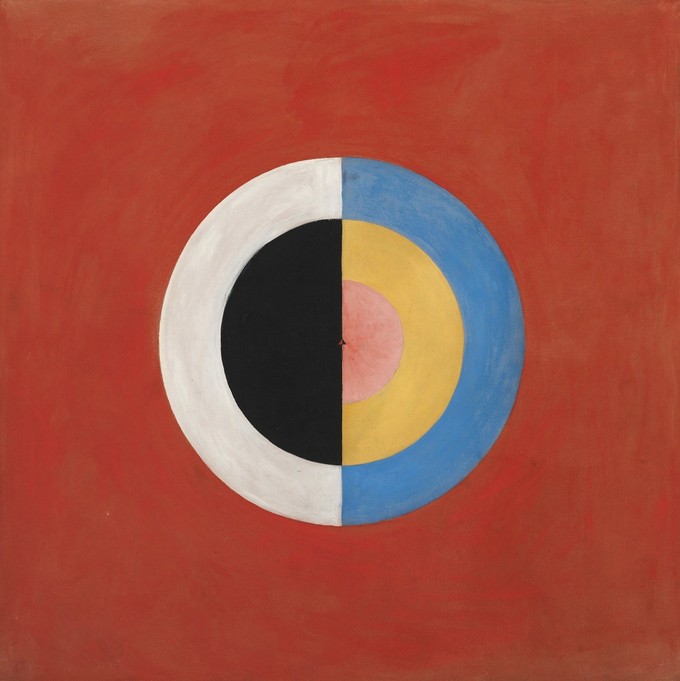
Hilma af Klint, Svanen (The Swan), 1914: Color and symmetry work together in this painting to guide the eye of the viewer in a particular visual rhythm.
Proportion and Scale
Proportion is a measurement of the size and quantity of elements within a composition.
Learning Objectives
Utilize the concept of proportion to different works of art
Key Takeaways
Cardinal Points
- Hierarchical proportion is a technique used in art, more often than not in sculpture and painting, in which the artist uses unnatural proportion or scale to depict the relative importance of the figures in the artwork.
- Mathematically, proportion is the relation between elements and a whole. In architecture, the whole is not just a building only the set and setting of the site.
- Among the diverse ancient artistic traditions, the harmonic proportions, human proportions, cosmic orientations, various aspects of sacred geometry , and small-scale whole-number ratios were all applied as part of the practice of architectural design.
Key Terms
- gold ratio:The irrational number (approximately 1·618), unremarkably denoted past the Greek letter φ (phi), which is equal to the sum of its own reciprocal and 1, or, equivalently, is such that the ratio of ane to the number is equal to the ratio of its reciprocal to 1. Some twentieth-century artists and architects accept proportioned their works to approximate this—especially in the form of the golden rectangle, in which the ratio of the longer side to the shorter equals this number—believing this proportion to exist aesthetically pleasing.
Proportion is a measurement of the size and quantity of elements inside a composition . Hierarchical proportion is a technique used in art, mostly in sculpture and painting, in which the artist uses unnatural proportion or scale to depict the relative importance of the figures in the artwork. In aboriginal Egyptian fine art, for case, gods and important political figures appear much larger than common people. Beginning with the Renaissance , artists recognized the connection between proportion and perspective , and the illusion of three-dimensional space . Images of the human being body in exaggerated proportion were used to depict the reality an artist interpreted.

Depiction of Narmer from the Narmer Palette: Narmer, a Predynastic ruler, accompanied by men carrying the standards of various local gods. This slice demonstrates the ancient Egyptians' use of proportion, with Narmer appearing larger than the other figures depicted.
Mathematically, proportion is the relation between elements and a whole. In architecture, the whole is not just a building but the set and setting of the site. The things that brand a building and its site "well shaped" include everything from the orientation of the site and the buildings on it, to the features of the grounds on which it is situated. Light, shade, current of air, elevation , and selection of materials all chronicle to a standard of architectural proportion.
Compages has frequently used proportional systems to generate or constrain the forms considered suitable for inclusion in a building. In almost every edifice tradition, there is a organization of mathematical relations which governs the relationships between aspects of the design. These systems of proportion are often quite uncomplicated: whole number ratios or incommensurable ratios (such as the golden ratio) were determined using geometrical methods. Generally, the goal of a proportional system is to produce a sense of coherence and harmony amid the elements of a edifice.
Among the various ancient artistic traditions, the harmonic proportions, human proportions, catholic orientations, various aspects of sacred geometry, and small whole-number ratios were all applied as function of the practice of architectural design. For instance, the Greek classical architectural orders are all proportioned rather than dimensioned or measured modules, because the earliest modules were not based on torso parts and their spans (fingers, palms, easily, and feet), only rather on column diameters and the widths of arcades and fenestrations .

Temple of Portanus: The Greek Temple of Portanus is an example of classical Greek compages with its tetrastyle portico of four Ionic columns.
Typically, one set of column bore modules used for casework and architectural moldings by the Egyptians and Romans is based on the proportions of the palm and the finger, while another less delicate module—used for door and window trim, tile piece of work, and covering in Mesopotamia and Hellenic republic—was based on the proportions of the paw and the thumb.
Dating back to the Pythagoreans, at that place was an idea that proportions should be related to standards, and that the more general and formulaic the standards, the better. This concept—that there should be dazzler and elegance evidenced by a skillful composition of well understood elements—underlies mathematics, fine art, and architecture. The classical standards are a series of paired opposites designed to expand the dimensional constraints of harmony and proportion.
Space
Infinite in fine art can be divers as the area that exists between 2 identifiable points.
Learning Objectives
Define space in fine art and list ways it is employed past artists
Central Takeaways
Primal Points
- The organization of space is referred to as composition and is an essential component to any work of art.
- The space of an artwork includes the groundwork, foreground, and middle footing , as well as the distance betwixt, around, and within things.
- At that place are ii types of space: positive infinite and negative space.
- After spending hundreds of years developing linear perspective , Western artistic notions nigh the accurate depiction of space went through a radical shift at the beginning of the 20th century.
- Cubism and subsequent modernist movements represented an important shift in the use of space within Western art, which is notwithstanding being felt today.
Key Terms
- space:The altitude or empty area betwixt things.
- Cubism:An artistic movement in the early on 20th century characterized by the depiction of natural forms equally geometric structures of planes.
The arrangement of space in art is referred to as limerick, and is an essential component of whatsoever work of fine art. Space can be generally defined equally the area that exists between any ii identifiable points.
Infinite is conceived of differently in each medium . The space in a painting, for example, includes the background, foreground and middle ground, while three-dimensional infinite, like sculpture or installation , will involve the altitude between, around, and within points of the piece of work. Space is further categorized equally positive or negative. "Positive infinite" tin exist divers equally the subject of an artwork, while "negative space" can exist divers as the space around the subject.
Over the ages, space has been conceived of in diverse means. Artists have devoted a neat deal of time to experimenting with perspectives and degrees of flatness of the pictorial plane .
The perspective system has been a highly employed convention in Western art. Visually, it is an illusionist phenomenon, well suited to realism and the depiction of reality every bit it appears. Later spending hundreds of years developing linear perspective, Western creative conventions well-nigh the authentic depiction of space went through a radical shift at the get-go of the 20th century. The innovations of Cubism and subsequent modernist movements represented an important shift in the apply of space inside Western art, the impact of which is still existence felt.

Pablo Picasso, Les Demoiselles d'Avignon, 1907: Les Demoiselles d'Avignon is an instance of cubist art, which has a trend to flatten the picture plane, and its employ of abstract shapes and irregular forms suggest multiple points of view within a single paradigm.
Two-Dimensional Infinite
Two-dimensional, or bi-dimensional, space is a geometric model of the planar project of the physical universe in which we live.
Learning Objectives
Discuss ii-dimensional space in fine art and the physical properties on which information technology is based
Key Takeaways
Primal Points
- In concrete terms, dimension refers to the constituent construction of all space and its position in time.
- Cartoon is a class of visual fine art that makes utilise of any number of instruments to mark a two-dimensional medium .
- Most any dimensional course tin can be represented by some combination of the cube, sphere, cylinder, and cone. One time these basic shapes have been assembled into a likeness, then the drawing can be refined into a more authentic and polished form.
Key Terms
- dimension:A single aspect of a given matter. A measure of spatial extent in a detail management, such as height, width or breadth, or depth.
- Two-Dimensional:Existing in two dimensions. Not creating the illusion of depth.
- Planar:Of or pertaining to a aeroplane. Apartment, 2-dimensional.
Two dimensional, or bi-dimensional, space is a geometric model of the planar projection of the physical universe in which we live. The two dimensions are usually called length and width. Both directions lie on the same plane . In physics, our bi-dimensional space is viewed as a planar representation of the space in which we motion.

Mathematical depiction of bi-dimensional space: Bi-dimensional Cartesian coordinate system.
In art composition , cartoon is a form of visual art that makes utilize of whatsoever number of drawing instruments to mark a two-dimensional medium (pregnant that the object does not have depth). One of the simplest and nearly efficient means of communicating visual ideas, the medium has been a pop and central ways of public expression throughout human history. Additionally, the relative availability of bones drawing instruments makes drawing more universal than most other media.
Measuring the dimensions of a discipline while blocking in the cartoon is an of import pace in producing a realistic rendition of a subject field. Tools such as a compass can be used to measure the angles of different sides. These angles tin can be reproduced on the drawing surface and then rechecked to make sure they are accurate. Some other grade of measurement is to compare the relative sizes of different parts of the subject with each other. A finger placed at a point along the drawing implement tin can be used to compare that dimension with other parts of the image. A ruler can be used both as a straightedge and a device to compute proportions. When attempting to draw a complicated shape such as a homo effigy, it is helpful at first to represent the course with a set of primitive shapes.
Almost any dimensional course can be represented past some combination of the cube, sphere, cylinder, and cone. One time these basic shapes take been assembled into a likeness, and so the drawing can be refined into a more accurate and polished course. The lines of the archaic shapes are removed and replaced by the last likeness. A more refined art of effigy drawing relies upon the artist possessing a deep agreement of anatomy and the human proportions. A trained artist is familiar with the skeleton structure, articulation location, muscle placement, tendon move, and how the different parts piece of work together during movement. This allows the artist to render more natural poses that do not appear artificially stiff. The artist is also familiar with how the proportions vary depending on the historic period of the subject, particularly when drawing a portrait.

Drawing homo figures: Henri de Toulouse-Lautrec's Madame Palmyre with Her Dog, 1897.
Linear Perspective and Three-Dimensional Space
Perspective is an approximate representation on a flat surface of an image equally it is seen past the middle.
Learning Objectives
Explain perspective and its bear upon on art composition
Key Takeaways
Central Points
- Systematic attempts to evolve a organisation of perspective are commonly considered to have begun around the fifth century B.C. in the art of Aboriginal Greece.
- The earliest art paintings and drawings typically sized objects and characters hierarchically according to their spiritual or thematic importance, non their distance from the viewer .
- In Medieval Europe, the employ and composure of attempts to convey distance increased steadily but without a ground in a systematic theory.
- By the Renaissance , virtually every creative person in Italia used geometrical perspective in their paintings, both to portray depth and too every bit a new and "of the moment" compositional method.
Central Terms
- curvilinear:Having bends; curved; formed by curved lines.
- horizon line:A horizontal line in perspective drawing, directly opposite the viewer's eye and often implied, that represents objects infinitely far away and determines the bending or perspective from which the viewer sees the work.
- vanishing point:The bespeak in a perspective drawing at which parallel lines receding from an observer seem to converge.
- Perspective:The technique of representing three-dimensional objects on a 2-dimensional surface.
In fine art, perspective is an estimate representation on a apartment surface of an prototype equally it is seen by the eye, calculated by bold a detail vanishing point . Systematic attempts to evolve a organisation of perspective are usually considered to take begun around the 5th century BCE in the art of Ancient Greece. Past the after periods of antiquity , artists—peculiarly those in less popular traditions—were well aware that distant objects could exist shown smaller than those shut at hand for increased illusionism. But whether this convention was actually used in a work depended on many factors. Some of the paintings plant in the ruins of Pompeii show a remarkable realism and perspective for their time.
The primeval art paintings and drawings typically sized objects and characters hierarchically co-ordinate to their spiritual or thematic importance, not their distance from the viewer. The most important figures are often shown every bit the highest in a composition , also from hieratic motives, leading to the "vertical perspective" common in the art of Ancient Egypt , where a group of "nearer" figures are shown beneath the larger figure(south).
The fine art of the Migration Flow had no tradition of attempting compositions of big numbers of figures, and Early Medieval art was dull and inconsistent in relearning the convention from classical models, though the procedure tin can exist seen underway in Carolingian art. European Medieval artists were aware of the general principle of varying the relative size of elements according to distance, and use and sophistication of attempts to convey distance increased steadily during the period, merely without a basis in a systematic theory.
Past the Renaissance, notwithstanding, virtually every artist in Italy used geometrical perspective in their paintings. Not simply was this use of perspective a manner to portray depth, but it was also a new method of composing a painting. Paintings began to show a single, unified scene, rather than a combination of several. For a while, perspective remained the domain of Florence. Gradually, and partly through the motility of academies of the arts, the Italian techniques became part of the training of artists across Europe and, later on, other parts of the earth.

Perspective in Renaissance Painting: Pietro Perugino'southward usage of perspective in this fresco at the Sistine Chapel (1481–82) helped bring the Renaissance to Rome.
A drawing has one-betoken perspective when it contains only one vanishing bespeak on the horizon line . This blazon of perspective is typically used for images of roads, railway tracks, hallways, or buildings viewed and then that the front is directly facing the viewer. Any objects that are made up of lines either direct parallel with the viewer's line of sight or direct perpendicular (the railroad slats) can be represented with one-bespeak perspective. These parallel lines converge at the vanishing point.
Two-point perspective tin be used to depict the same objects every bit one-indicate perspective, only rotated—such as looking at the corner of a house, or looking at ii forked roads compress into the altitude. In looking at a house from the corner, for example, one wall would recede towards 1 vanishing betoken and the other wall would recede towards the opposite vanishing point.
3-point perspective is used for buildings depicted from above or below. In addition to the two vanishing points from before, one for each wall, there is now a third ane for how those walls recede into the basis . This third vanishing indicate would be below the basis.
Four-point perspective is the curvilinear variant of two-point perspective. The resulting elongated frame tin be used both horizontally and vertically. Like all other foreshortened variants of perspective, 4-point perspective starts off with a horizon line, followed by four equally spaced vanishing points to delineate four vertical lines. Because vanishing points exist simply when parallel lines are present in the scene, a perspective with no vanishing points ("zero-betoken") occurs if the viewer is observing a non-rectilinear scene. The most common instance of a nonlinear scene is a natural scene (due east.thou., a mountain range), which frequently does non contain any parallel lines. A perspective without vanishing points can withal create a sense of depth.
Distortions of Space and Foreshortening
Distortion is used to create various representations of infinite in 2-dimensional works of art.
Learning Objectives
Place how baloney is both employed and avoided in works of fine art
Key Takeaways
Fundamental Points
- Perspective projection baloney is the inevitable misrepresentation of iii-dimensional space when drawn or "projected" onto a two-dimensional surface. It is impossible to accurately draw 3-dimensional reality on a 2-dimensional plane .
- However, there are several constructs available which allow for seemingly accurate representation. Perspective projection tin can be used to mirror how the centre sees by the utilise of 1 or more vanishing points .
- Although distortion can be irregular or follow many patterns, the most commonly encountered distortions in composition , especially in photography, are radially symmetric, or approximately so, arising from the symmetry of a photographic lens.
Central Terms
- radial:Arranged similar rays that radiate from, or converge into, a common center
- projection:The image that a translucent object casts onto some other object.
- foreshortening:A technique for creating the appearance that the object of a drawing is extending into space by shortening the lines with which that object is drawn.
A distortion is the alteration of the original shape (or other characteristic) of an object, image, sound, or other form of information or representation. Distortion can be wanted or unwanted by the artist. Baloney is ordinarily unwanted when it concerns physical degradation of a piece of work. Withal, it is more than usually referred to in terms of perspective, where it is employed to create realistic representations of space in 2-dimensional works of art.
Perspective Project Baloney
Perspective projection distortion is the inevitable misrepresentation of three-dimensional space when fatigued or "projected" onto a two-dimensional surface. It is impossible to accurately depict iii-dimensional reality on a two-dimensional plane. However, there are several constructs available that allow for seemingly accurate representation. The almost common of these is perspective projection. Perspective projection can be used to mirror how the eye sees by making use of ane or more vanishing points.

Giotto, Lamentation (The Mourning of Christ), 1305–1306: Giotto is one of the most notable pre-Renaissance artists to recognize distortion on two-dimensional planes.
Foreshortening
Foreshortening is the visual effect or optical illusion that causes an object or distance to appear shorter than it actually is because it is angled toward the viewer . Although foreshortening is an of import element in art where visual perspective is being depicted, foreshortening occurs in other types of two-dimensional representations of three-dimensional scenes, such as oblique parallel projection drawings.
The physiological ground of visual foreshortening was undefined until the year 1000 when the Arabian mathematician and philosopher, Alhazen, in his Perspectiva, first explained that calorie-free projects conically into the eye. A method for presenting foreshortened geometry systematically onto a plane surface was unknown for another 300 years. The artist Giotto may have been the commencement to recognize that the paradigm beheld by the eye is distorted: to the centre, parallel lines appear to intersect (like the distant edges of a path or road), whereas in "undistorted" nature, they practice non. In many of Giotto'southward paintings, perspective is employed to achieve various distortion effects.

Foreshortening: This painting illustrates Melozzo da Forlì's usage of upward foreshortening in his frescoes at The Basilica della Santa Casa.
Distortion in Photography
In photography, the projection machinery is light reflected from an object. To execute a drawing using perspective projection, projectors emanate from all points of an object and intersect at a station point. These projectors intersect with an imaginary plane of project and an epitome is created on the plane by the points of intersection. The resulting paradigm on the project aeroplane reproduces the image of the object as it is beheld from the station betoken.
Radial distortion tin can usually be classified as ane of 2 main types: barrel baloney and pincushion distortion. Butt distortion occurs when image magnification decreases with distance from the optical axis. The apparent effect is that of an image which has been mapped around a sphere (or barrel). Fisheye lenses, which have hemispherical views, utilize this blazon of distortion every bit a way to map an infinitely broad object plane into a finite image area.
On the other hand, in pincushion distortion, the image magnification increases with the altitude from the optical centrality. The visible effect is that lines that do non become through the center of the paradigm are bowed inwards, towards the middle of the prototype, similar a pincushion. A certain corporeality of pincushion distortion is often found with visual optical instruments (i.east., binoculars), where it serves to eliminate the globe effect.
Cylindrical perspective is a form of distortion caused by fisheye and panoramic lenses, which reproduce directly horizontal lines higher up and below the lens axis level as curved, while reproducing straight horizontal lines on lens axis level every bit direct. This is as well a common characteristic of wide-angle anamorphic lenses of less than 40mm focal length in cinematography. Substantially information technology is just barrel distortion, but just in the horizontal aeroplane. It is an artifact of the squeezing process that anamorphic lenses practice to fit widescreen images onto standard-width motion picture.
Source: https://courses.lumenlearning.com/boundless-arthistory/chapter/visual-elements/
0 Response to "In Art Can Be Defined as a Moving Dot"
Post a Comment